CONSULTING INIGHTS
Building the Modern Consultancy Growth Engine
A practical playbook for consulting leaders
15 min read

Author
Ellen Price

Author
Mike James

Author
Duncan Ramsay
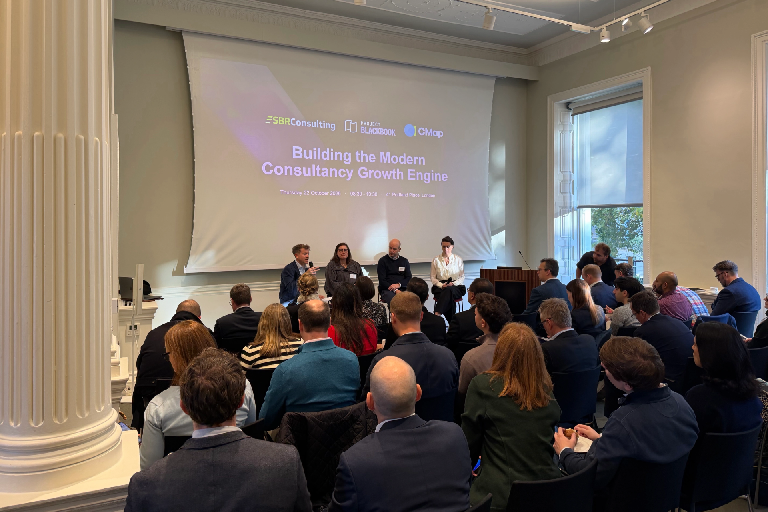
This playbook is co-authored by SBR Consulting, Project Blackbook and CMap. It draws on the insights shared at the breakfast panel our three firms hosted in London on 22nd October 2026 for senior consulting leaders.
Mike James of Project Blackbook chaired the panel, with Ellen Price of SBR Consulting and Duncan Ramsay of ECI Partners, whose portfolio includes CMap. They were joined by Teresa Allan of Magnus Consulting and Hannah, an AI coach who took questions from the room. Here is what we heard, turned into actions you can start on straight away.
What this playbook covers, and what you’ll gain
- Brand to demand: how to turn trust into demand from the clients you actually want.
- Who wins the work: what “hunter” and “farmer” should mean now, and who should be selling.
- Speed to respond: two fixes for what to do when a potential client calls…
- AI and commercial capability: where AI takes real load off winning work, and where it still needs a human.
Each section ends with a to-do list, and there’s a checklist at the end for your 2027 planning.
The thread through all four is predictability: building a growth engine that doesn’t rely on a few rainmakers, a few big clients and a delivery bench that is either overstretched or idle. As Duncan put it:
“For us, growth is a given. What differentiates a professional services business is repeatability, scalability and predictability.”
1. Brand to demand
Ask yourself: Is your brand the firm, or just your rainmakers?
What the research says
- 63% of CROs have little or no confidence in their ideal client profile, or ICP, and ICP misalignment can cut win rates by up to 75% (Fullcast, Pavilion, SBR Consulting).
- Only 35% of go-to-market (GTM) leaders are very confident of hitting their growth target (Magnus Consulting).
- 58% of leaders with fully aligned sales and marketing are very confident of hitting target, against 33% where teams are only mostly aligned (Magnus Consulting).
Most consultancies are known and trusted. The question is whether that trust belongs to the firm or to a few partners whose names open doors, and investors notice the difference. Duncan explained what ECI looks for:
“In the firms I look at, the bulk of new business is repeat and referral. What we focus on is who is driving it. Dependence on one or two rainmakers is a pattern we see often in this market, and it can give us cause for concern.”
If one person brings in 80% of your new business and they leave… that’s a problem.
Define the ICP before you choose the channels
Every channel works harder when it points at the same clients: in Duncan’s words, the area where you have a disproportionate right to win. Teresa’s advice is to understand what makes those clients buy. As Teresa explained:
“Work backwards from your clients’ challenges to the triggers that move them from the 95% who are out of market to needing your help. Most clients, even big global enterprises, can’t fully identify those triggers.”
Consulting sits fairly far down the maturity curve on defining its ICP, Ellen notes, because so many firms have founder-led roots.
Make proof do the selling, then ask for the referral
Case studies mapped to your clients’ triggers, with real evidence of impact, speak louder than anything else and show existing clients your breadth. Judge thought leadership by whether it engages the accounts you want, gets used with clients and helps opportunities progress.
Then ask for the referral. Ellen cited the widely quoted finding that more than nine in ten people say they would give a referral, yet only 11% of us ask. That is a lot of untapped money left on the table. Teresa’s tip: follow every high NPS score with, “Can you refer me to someone else?” Duncan explains why referrals win:
“These tools are really helpful, but they’ve become mutually assured destruction. Cold emails are all automated, so I largely ignore them. Referrals and your network are the way to do it. The first question I ask is: does someone I know, know them?”
Align around the same clients and the same story
Real alignment means shared target clients, priorities and accountability, including partners and delivery consultants, reviewed weekly or fortnightly with clear actions and owners. The story matters too. Many mid-sized firms are still in their teenage years, in Ellen’s phrase, and she sees a gap between the vision written at board level and what happens in front of clients. As Ellen put it:
“People who have been describing the company one way for years now need to relearn, and believe, a new narrative.”
Your to-do list
- Write your ICP in one sentence: which clients, which problems, and where you have a disproportionate right to win. Ask three partners to do the same, and compare.
- List your top five triggers and the case studies that prove you can respond to each.
- Make the referral ask routine after every strong NPS score or successful milestone.
- Run the rainmaker test: what share of last year’s new business came from your top three people?
- Give your people the new narrative, and time to practise it before they use it with clients.
The bottom line: your brand belongs to the firm when everyone can tell the same story to the right clients at the moment they need you.
2. Who wins the work
Ask yourself: Do ‘hunter’ and ‘farmer’ still mean anything in consulting? Do you have a dedicated business development (BD) team, or experts selling their own work, and who is right? And does everyone who wins and grows work need to be on your payroll?
What the research says
- There is a 60 to 70% chance of selling to an existing client, against 5 to 20% for a new prospect (widely quoted benchmark, Marketing Metrics).
- A commonly cited private equity comfort zone is more than 30% of revenue from new clients and no single client above 20%.
The maths pulls every firm towards farming, but it has limits. As Mike put it:
“Take it too far and you end up with a concentration problem. If your flagship client walked out of the door, you’d be in serious trouble.”
For ECI, the questions start well below that benchmark. Duncan explained:
“It isn’t a hard number. Once a client passes 10% of your revenue, we want to understand the relationship, and there are often ways of getting comfortable with that. Past 30%, it’s hard to see what would get us comfortable.”
Treat hunting and farming as different jobs
“Across our industry, we need to accept that we have an origination problem,” Ellen said, and the peaks and troughs of delivery give everyone somewhere to hide. Ellen was blunt about it:
“When people tell me, ‘I didn’t get into consulting to become a salesperson,’ I want to say: that’s exactly why you got into consulting. The pinnacle of consulting is sales.”
She set out three shifts:
- Take growth seriously as a career path. Technology has a clear, well-paid route from SDR to VP. When Ellen started in growth in 2001, PwC had no such route past senior manager.
- Stop treating hunting and farming as levels of seniority. They are different disciplines, and strong originators may sit below partner, unnoticed.
- Reclaim the word ‘hunting’. It has become a derogatory term.
Ellen’s favourite illustration came from a partner who insisted she was definitely more of a farmer. The partner told her:
“A lovely lead came in from marketing and everybody just stared at it. I noticed it was in Guildford, and we were driving through on our way to Center Parcs. So I left my family at the shopping centre, had a coffee with the guy, and now I’ve got 150k of work.”
“That sounds like hunting”, Ellen replied. SBR’s Managing Director, Alan Morton, later pointed out that the Greek deity of hunting was a goddess, Artemis.
Match your BD model to what the client is buying
Duncan sees the split working for team sport offers. At Croud, the digital marketing business in ECI’s portfolio, a pitching team hunts and a client team farms, much as in a software business. It’s different when the client is buying an individual’s expertise. Duncan, speaking as a buyer:
“When an individual practitioner is the product, I’m buying their judgement and experience, not the team around them. Put a hunter between me and that person and it becomes quite frustrating. They’re not adding value, and they’re not driving any revenue upside either.”
Ellen agrees a separate BD layer suits pre-sales and productised or technical offers. The risk is that reluctant sellers take the technical off-ramp, leaving three or four people doing all the selling.
Check incentives, account plans and procurement
- Incentives. Partner economics often reward the opposite of what firms want, and Ellen sees new delivery targets creating short-termism. If everyone is expected to sell, who owns the pipeline?
- Account plans. Too many are very nose in front of face, Ellen says. Plan for long-term potential, and test your vision with key accounts in Q4 so the feedback shapes next year’s investment.
- Procurement. To get past preferred supplier lists, Ellen asks first whether procurement is even on your account plan: “If you know their purchasing process better than your buyers do, you can take massive time out of the deal.”
Look beyond the payroll
Mike’s view: “Independents are a growth channel, not only delivery capacity. They’re on site, so they hear the next need first. Pay them for it, with an introducer fee or a share of the follow-on work, and they’ll farm the account.”
Senior independents also bring their own networks and, on bids, add named, credible expertise without the bench cost.
Your to-do list
- Map who really originated last year’s new work, including people below partner.
- Assess capability, not seniority, and develop hunters and farmers differently.
- Build a visible growth career path, with partner economics that reward origination.
- Choose your BD model offer by offer, and review any client above 10% of revenue.
- Formalise an introducer model for independents, and name senior independents on bids.
The bottom line: independents sit inside client accounts and hear the next need first. Incentivise them and they farm; the senior ones can hunt and strengthen bids.
3. Speed to respond
Ask yourself: A client calls on Monday with a need for the following week. How fast can you say yes with the right people? And what fixes it: knowing who you already have, or being able to flex who you can call on?
What the research says (from Dayshape, October 2026, 400 senior leaders in UK and US firms)
- 55% have missed, delayed or turned down client work because of capacity constraints.
- 53% say staff availability and skills matching are hitting their margins.
For many firms the demand is there; the bottleneck is staffing it fast enough. As Mike put it, “there’s been a narrative for a while that the time and materials model is dead, but actually, firms can’t find the people.”
Decide what you say no to
Ellen took it back to strategy: “Strategy is defined by what you say no to rather than what you say yes to. If we’re really certain of our specialist pathway, we have to start saying no a bit more.”
Some of the best firms she works with put a GTM triage layer between demand and supply. It filters demand against their key propositions and feeds what it learns back to delivery and product.
Make demand and supply predictable
For Duncan, the answer is to see demand coming, know when it will need resourcing and staff it well, whether with temporary resource or your own people. Investors judge that predictability all the way through to cash.
Duncan’s predictability test
- Can you forecast demand accurately?
- Can you price it well?
- Can you use that visibility to manage resourcing and utilisation?
- Can you get invoices out and cash in on time?
Few consultancies have subscription revenue, so find the achievable version: a subscription tool or data platform, a managed service, a retainer, or evidence of a tightly managed resource model. The more you can demonstrate predictability, Duncan said, the more value you create in the eyes of investors.
Grow without simply adding people
Teresa’s answer is a systematic approach: frameworks and IP first, then data and AI for the heavy lifting. Her headcount test starts with the work: Is it repeatable? Is it clear to everybody how you do stuff, and can everybody do it?
One more question for your leadership team: if you could flex capacity on demand, would fixed-price work become safer?
Your to-do list
- Run the Monday test: time how long it takes to confirm a named, available, suitably skilled team for a realistic client request.
- Add a triage step between demand and supply that filters work against your strategy.
- Connect pipeline to resourcing, so staffing starts when an opportunity is qualified, not when it is signed.
- Score yourself on Duncan’s predictability test, and fix the weakest link first.
The two fixes
- Visibility: a live view of who is free, with which skills, and from when. That is what resource planning tools such as CMap provide.
- Flexibility: a vetted bench of independents you can scale up for a bid or a start date, so sellers can say yes without overstretching the core team.
4. AI and commercial capability
Ask yourself: Where is AI taking real load off winning work, and where does it still need a human? Is it making your average sellers better, or just faster?
What the research says
- 81% of leaders say AI has a significant influence on their go-to-market, but only 18% use AI insight as a primary input to decisions (Magnus Consulting).
- Organisations that used AI to improve deal quality grew revenue per seller by 61%; those that used it to flood the top of the funnel saw it fall by 26% (Fullcast, Pavilion, SBR Consulting).
Let AI watch for the triggers
Client triggers, such as a regulatory change, happen every day, and firms used to take months to respond. Many of Teresa’s clients now use AI to surface those signals as they happen, with marketing and sales meeting weekly to ask of each alert:
- Is this important?
- Does it align with our triggers and our strategy?
- Are we going to act, and if so, how? It might be a campaign, or simply the account lead picking up the phone.
“If you’re not reacting in real time, your competitors will be,” Teresa warned. Tools such as Clay help, but without a deep understanding of your customers’ triggers, no amount of Clay or anything else will be contextually relevant.
Keep people on the judgement calls
AI can surface the signal, but people still validate the evidence and make the commercial call, quickly and together. As Teresa put it:
“If we can understand a change in hours but take three weeks to agree what to do about it, the next improvement has to be in how we work together.”
Ellen pointed to benchmark research showing that the organisations doing well use AI for quality rather than quantity, which only works if AI is scaling the right behaviour. Ellen warned:
“As one of my clients said, the danger with AI is that we create faster caterpillars. You want to scale the best practice, not the worst, and you won’t do that unless your one-firm methodology is the guardrail.”
SBR applies this to itself. Its methodology is built into its call tool, every call is scored against it, and where a consultant falls short, the tool routes them to a colleague who handled that moment well.
Leadership matters too. If an AI coach is a substitute for leadership, Ellen says, you have a bigger problem. Mike urged leaders to model AI-first habits themselves: keep it open as a tab on your desktop and always use it, even when you don’t have to.
Better, or just faster? We asked the AI
In Hannah’s words: “I’m not the end of sales coaching culture, and I’m definitely not a replacement for the best human coaches. What I do well is repetition and preparation at scale, which frees partner time for the conversations that genuinely need judgement.”
She helps before a meeting (a tight objective, a clear point of view and two or three questions worth asking), after it (turning notes into next steps) and before high-stakes conversations (a quick role-play to say the awkward bit out loud). Her advice:
“Treat me like a rehearsal space, not a reference book. Instead of ‘we can help with transformation’, come with: ‘We’re meeting the CFO on Thursday. Our aim is to agree the one decision she wants to make in the next 90 days.'”
The most common mistake she sees is people trying to be impressive instead of trying to be useful. Open with a hypothesis and two sharp questions, not credentials. Her closing thought:
“AI doesn’t make coaching less important. It makes it finally available to everyone, before every meeting, without rationing partner time.”
So, better or just faster? On the panel’s evidence, better, when AI is built on a clear methodology, used for practice rather than shortcuts, and backed by leaders who spend their own time on the judgement calls. Without those, just faster.
What investors expect
For Duncan, AI is now table stakes, but adoption alone won’t earn a premium. As Duncan put it:
“If it’s just a story, it shouldn’t get rewarded. If there’s compelling, ideally quantified, evidence of it giving a material edge that will compound over the investment period, then it should have value.”
Pricing in the messy middle
AI can make some outputs five or ten times faster, yet time and materials is still the most common model, and clients want a share of the efficiency. No one has the perfect answer yet, Duncan said, but the panel offered four moves:
- Sell the change, not the hours. Clients bring consultants in to embed change, Teresa says, so use AI to speed up the upfront work and invest the time in behavioural change.
- Be brave on value-based pricing. “The number of times I wish we’d done a deal on a percentage of the uplift we’ve given clients,” Teresa said. “We could probably all have gone home and retired by now.”
- Take cost out and layer your fees. Croud is automating workflows so a dip in the top line matters less, and adding success-based and technology fees to a base fee.
- Expect transitional models, such as fixed-price agile and fees at risk, and, as Ellen says, control what you can control.
Ellen’s practical fix: “A surprising number of clients aren’t measuring impact. Agree the KPIs at the front end, capture them, replay them and build them into your case stories. Even if pricing isn’t catching up, it sure helps your win rate.”
Your to-do list
- Start a weekly signals meeting for marketing, sales and account leads.
- Point AI at quality before volume: qualification, account research and meeting preparation.
- Make your methodology the guardrail, and score conversations against it.
- Give everyone a rehearsal space before important meetings, and save partner time for judgement calls.
- Measure the edge on win rates, sales cycles or margin, so you can evidence it.
- Agree success measures at the start of every engagement.
The bottom line: AI makes a good process faster and good coaching available to everyone. It won’t fix an unclear ICP, a weak methodology or a gap in leadership.
Your growth engine checklist
This week
- Write your ICP in one sentence, and ask three partners to do the same.
- Ask one happy client who else you should be talking to.
- Run the Monday test on a realistic client request.
This month
- Start a weekly sales, marketing and account review built around triggers.
- Map who really originated last year’s new business.
- Put procurement on every key account plan.
Before you lock your 2027 plan
- Test your long-term vision with key accounts.
- Get a live view of who is available, with which skills, and from when.
- Build a vetted bench of independents, with an introducer model.
Growth that depends on a few heroes is fragile. Growth built as a system is repeatable, scalable and predictable and, as Duncan reminded us, that is what creates value in the eyes of investors.
Your hosts
If any of these themes live in your firm, we’d be glad to compare notes. Connect with any of us on LinkedIn.
Ellen Price, Head of Professional Services, SBR Consulting
Across professional services, Ellen has won major international contracts, worked for PwC, scaled 5 investor backed businesses, lived on multiple continents, and built teams to deliver cohesive, winning strategies.
Mike James, Founder, Project Blackbook
Mike James has worked as a Management Consultant for EY for around 7 years before becoming an independent consultant, typically working as an Interim Transformation Director for complex programmes. He later founded Project Blackbook – a dedicated service to help consultancies scale their team, risk free, by providing access to a tailored bench of on-demand independent consultants.
Duncan Ramsay, Partner, ECI Partners
A strategy professional with over 20 years of global in-house, consulting and investment experience focused on growth. ECI’s portfolio includes CMap.