WEALTH MANAGEMENT INSIGHTS
How AI can generate real enterprise value and where to focus your efforts
5 minute read
The narrative around artificial intelligence (AI) has evolved almost as fast as the technology itself. While the initial wave of generative AI tools, led by ChatGPT, sparked panic and awe amongst financial advisers, the industry soon settled into a comfortable story about operational efficiency.
AI would automate dull, repetitive tasks like report creation and meeting scheduling, freeing advisers to focus on high-level strategic work. Far from rendering advice obsolete, the technology would usher in a new era of flourishing for the industry.
But then a problem became apparent: operational efficiency has a very clear upper limit. For an industry built around M&A, where enterprise value is among the most valuable forms of leverage, having every firm chasing the same handful of use cases leads to diminishing returns.
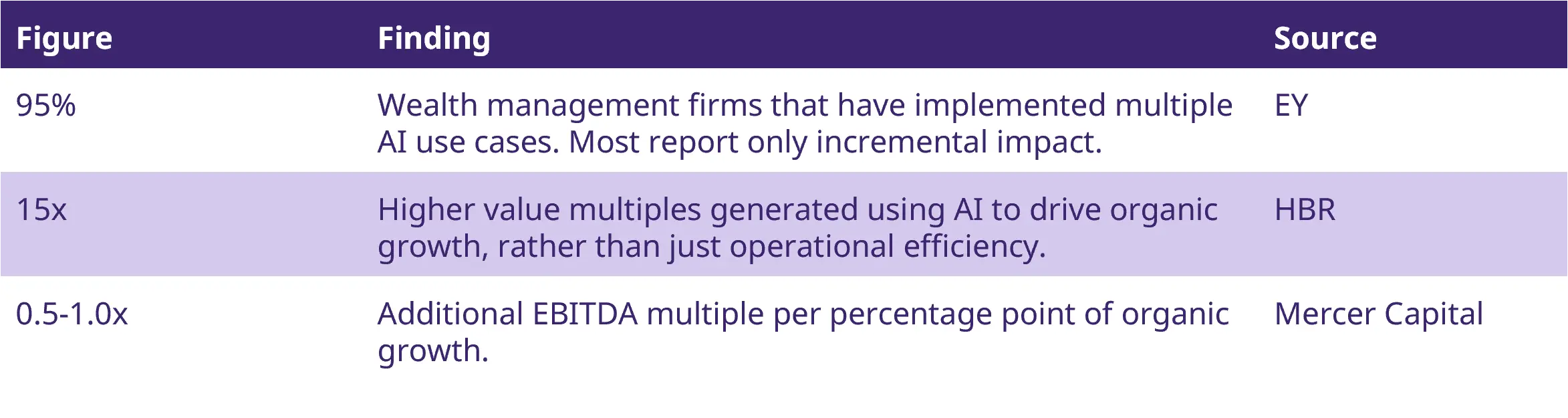
So the narrative changed again. AI-driven efficiency was table stakes; what mattered was using AI to generate growth. Analysis in the Harvard Business Review found that using AI to fuel organic growth would generate 15x more enterprise value than focusing on efficiency.
That vision chimes with our experience, which is that organic growth is the strategic priority for most wealth management firms today. Yet it leaves a rather difficult question unanswered: how exactly will AI help firms generate organic growth and build enterprise value?
Why efficiency delivers diminished returns for enterprise value
The first wave of AI adoption within wealth management is complete, with 95% of firms successfully having implemented multiple use cases. Yet the results have been mixed. Most firms describe the technology’s impact as “incremental,” while 86% say the regulatory complexities surprised them.
Incremental improvements should be better than nothing. But while firms ran pilot projects and raced to integrate AI within daily operations, the technology emerged as a potential threat from without.
An AI-enabled tax planning platform wiped $20 billion in market value from publicly traded firms in the US in 2026. Fears that robo-advisers and similar tools using AI would undercut the established wealth management market loomed large.
This crystallised the real urgency behind AI adoption. The race is not to build a better operating model, but to demonstrate the viability of your firm. And that makes efficiency the wrong metric to focus on for two reasons.
First, efficiency has an inherent upper limit. Once every repetitive task is automated, there is relatively little room to expand AI use cases. Automation beyond that starts to undermine human advisers. Firms that push the efficiency use case too far end up accelerating the obsolescence of their own service model.
That upper limit is likely not high enough to justify the costs required to reach it. As EY’s Ugur Hamaloglu says, “the capital investment required by AI cannot be supported by cost reduction alone.” For an industry already struggling with dwindling margins, unsupported capital expenditure couldn’t look worse during M&A negotiations.
That leads us to the second case against focusing on efficiency: enterprise value is increasingly a positional good.
It hinges on comparison to other firms the acquirer might purchase. Leaders no longer only want to purchase scale; they want to fill gaps in their service line, solve strategic problems, and future-proof their operating model.
That places a premium on factors that are rare or highly prized, such as organic growth and the capacity to attract underserved demographics. When AI becomes the operational standard, and virtually all firms automate repetitive tasks, the efficiency gains are rendered moot.
Advisers and back-office teams benefit from more time, but the improvement is unlikely to drive value multiples.
How organic growth can deliver real value multiples
The case for AI as a growth enabler involves three basic parts:
- Extra time for commercial activity: Firms can use the efficiency gains AI offers to focus on organic growth. Advisers currently cite “lack of time” as their number one barrier to growth, and roughly 85% struggle to allocate time to marketing. But if AI can save advisers 10-15 hours every week, that time could be reallocated to prospecting, client engagement, and other work that wins new clients and assets.
- Enhanced insights for commercial activity: AI can use market signals, client data, and predictive analytics to give advisers a deeper understanding of their clients and prospects. Systems like automated lead scoring help allocate commercial time more effectively, while AI-augmented meeting prep can deliver better service and increase retention or even expand wallet share.
- Improved marketing channels: AI can help firms optimise various elements of their marketing system, such as LinkedIn ads, enabling them to develop a more effective pipeline. Advisers can complete more outreach faster, with precisely personalised messaging that helps them build rapport faster.
These elements converge to make AI a powerful engine to fuel organic growth. A recent BCG analysis argues this will reshape the economics of wealth management:
“If AI reduces client acquisition and servicing costs significantly, growth will no longer depend primarily on poaching relationship managers or pursuing acquisitions. Direct client acquisition becomes more economical, and firms that build those capabilities early will find themselves with a structural advantage that compounds over time.”
The report suggests that “AI-first” wealth managers can unlock:
- 10-25% better conversion rates
- 5-10 pp NPS improvements
- 25-30% increased adviser capacity
This is expected to generate 15-20% more revenue per adviser through cross-sells, retention, and client acquisition. That growth will translate into tangible enterprise value; some analysis finds that firms add 0.5-1.0x EBITDA multiple per percentage point of organic growth.
But AI adoption will not automatically generate organic growth. More adviser capacity and data-driven insights will simply generate more wasted time and effort if they are funnelled into a commercial programme that is built around the wrong incentives, value proposition, and positioning.
Three ways firms must prepare to use AI for organic growth
1. Commercial strategy
Organic growth occurs when firms present the right offer to the right audience niche. But most advisers built their books several years ago, leaving them with a set of assumptions about their target audience and the market reality that is usually outdated.
That has always been a constraint on organic growth; today, it’s an active liability. Client expectations have changed rapidly as financial advice became easily accessible online, while both client demographics and how they discover advisers have shifted.
Advisers need a value proposition and positioning statement that reflect their current reality. They must understand which clients they are targeting; what those clients care about; and how they actually engage with wealth management firms. Otherwise, no amount of AI-enabled insights will help them connect or convert prospects.
2. Enablement
One reason poor commercial strategies persist is they can’t be effectively tested without the right execution. When advisers lack the time or capabilities required to win prospects’ attention and build relationships, it’s hard to tell whether your value proposition or audience targeting is correct.
Enablement is all about building structures that support the execution your strategy requires. With the right plans, processes, and incentives, advisers can undertake the commercial behaviours you want consistently. That includes hiring the right people; identifying those with real commercial potential; and developing the capabilities that most strongly influence organic growth.
3. Effectiveness
Enterprise value requires not just strong organic growth, but repeatable performance. Short bursts of inspiration or a handful of skilled advisers can generate real traction; only a formalised, scalable system will let you drive sustained organic growth.
Effectiveness is about instilling the right mindset, platforms, and skills to support commercial habits. AI is the perfect use case: while the technology can save time and augment commercial activity, it relies on advisers knowing how to use it properly and integrate it into their daily routines.
That makes it a crucial capability, which is why we started measuring it. AI fluency is a part of SBR’s proprietary capability assessments, enabling us to quantify each adviser’s current competency and their potential to develop it. That helps leaders deliver targeted development programmes that generate the highest ROI, as well as allowing you to quantify the expected impact specific development programmes will have on organic growth.
Curious how fluent your front office is with AI?