H1 2026 Report
The state of sales:
Insights in AI & modern sales practices in professional services
10 min read

Author
Bart Kowalczyk
AI in professional services: Opportunity and risk
This report aims to help professional firms to:
- Understand the real state of sales and growth in the current market.
- Clarify where AI and automation can create value in the sales journey.
- Learn from live examples, client discussions, and panellist experience.
- Translate insight into practical actions.
Context and purpose
Professional services firms are navigating a difficult balance:
- Economic conditions that constrain growth expectations.
- Clients are demanding greater value, transparency, and measurable outcomes.
- Rapid advances in AI and automation.
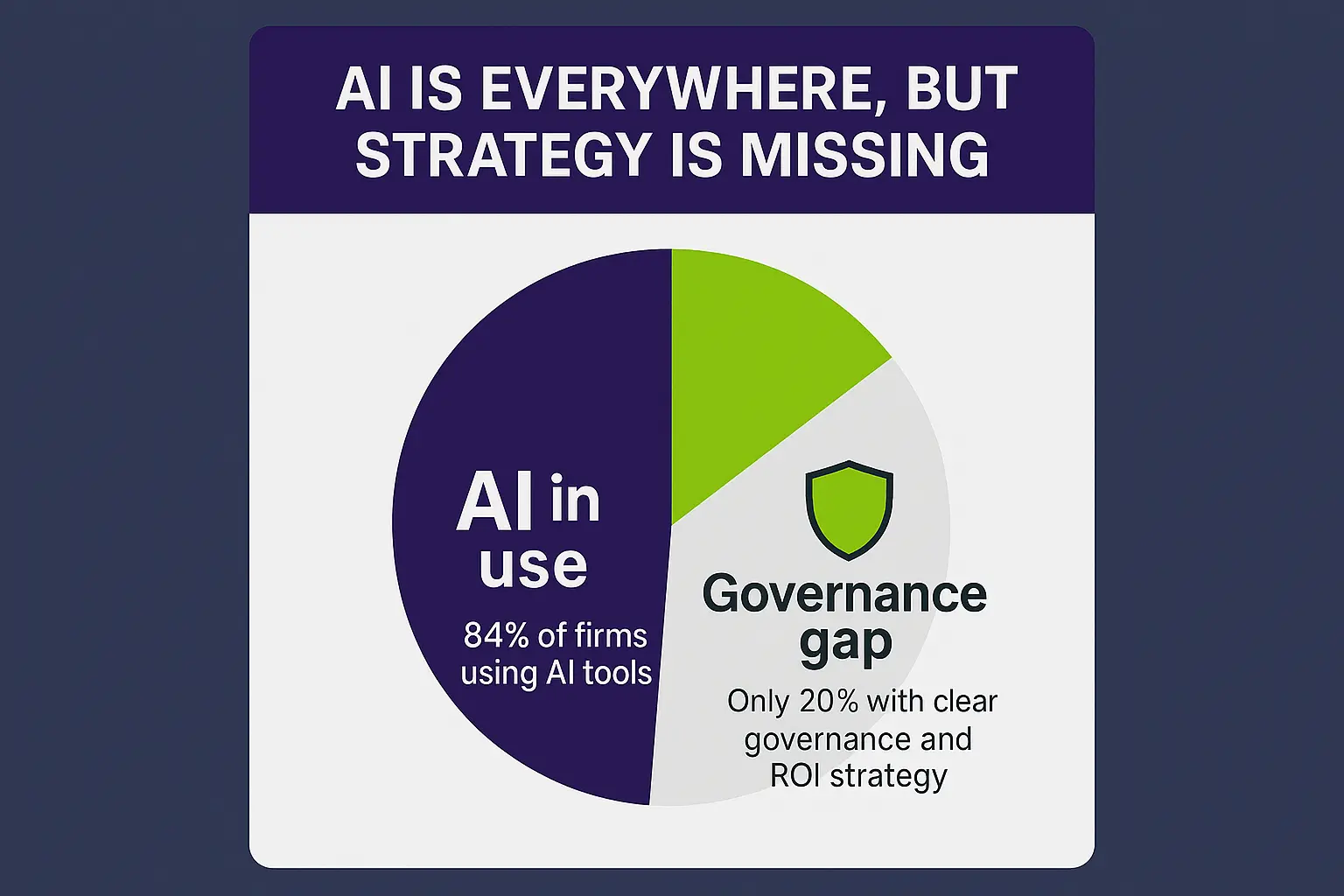
A need to professionalise sales and business development without undermining the existing culture. Research referenced during the event shows that around 84% of businesses already using AI, yet few have a fully formed strategy, governance framework, or clear ROI model.
The new buying journey: Why digital reputation matters
- Three major trends dominate the sales landscape:
- AI adoption is widespread but lacks clear governance and ROI.
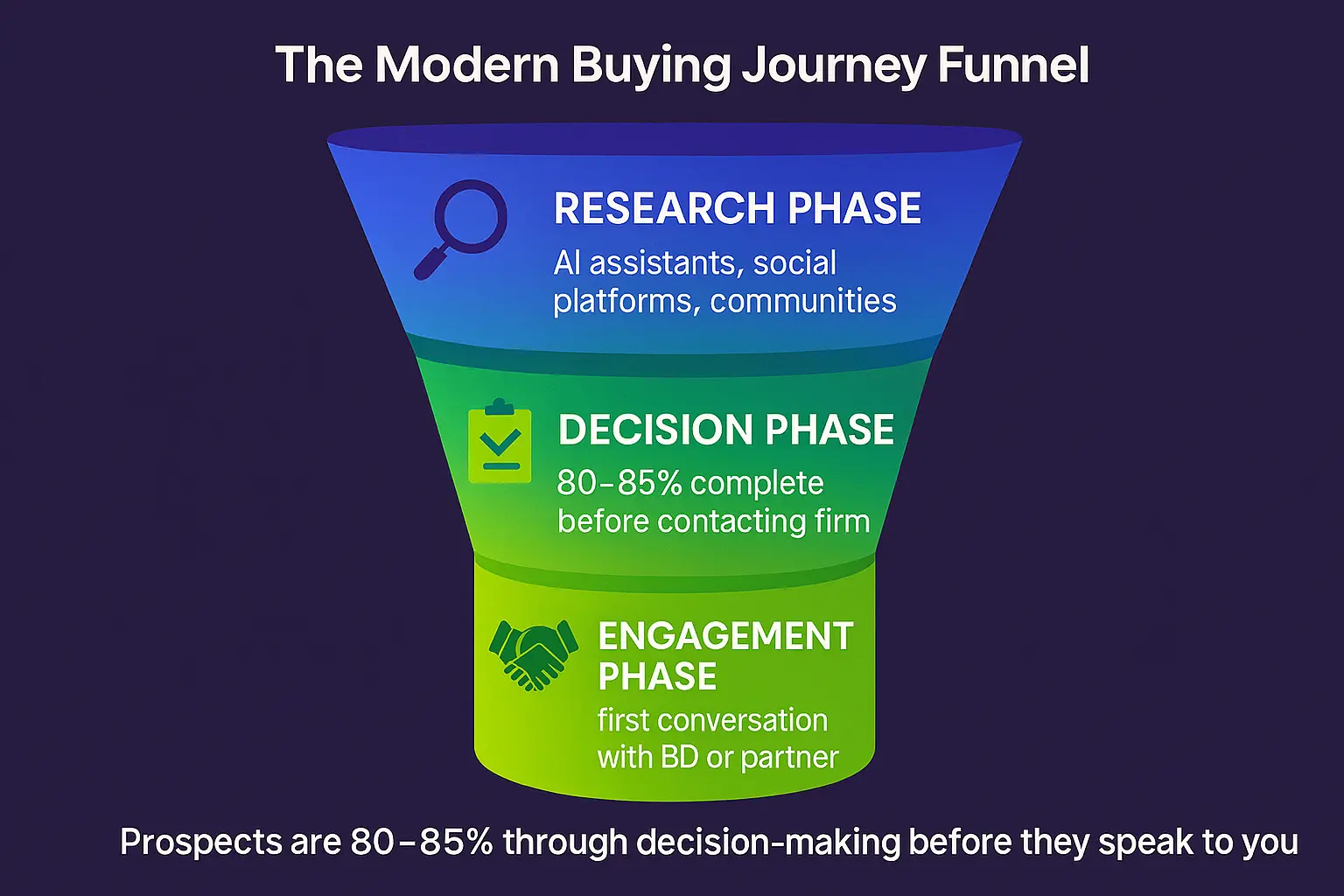
- Buyers are 80–85% through their decision-making before engaging, making digital reputation critical.
- Sales cycles are lengthening, but trust-based approaches and clear positioning can reverse this trend.
Insight 1: AI adoption is widespread, but strategy, governance, and ROI are lagging
Strategic implication
Tim Hillier (EY) stressed that too many organisations start with the technology rather than the problem.
The more effective approach is:
- Define the commercial or operational challenge (e.g. “reduce proposal turnaround time by 40%”, “increase partner BD productivity”, “improve win-rates”).
- Align commercial leaders and the CFO on target outcomes and acceptable risks.
- Only then select and embed AI tools to support those outcomes.
AI should therefore be seen as a means to a clearly defined end, not an experiment in search of a justification.
What we heard
In the room, almost everyone raised their hand when asked if they were using AI in their business, typically tools such as ChatGPT, Copilot, or Gemini. This mirrored wider research suggesting that over 80% of organisations are now experimenting with AI.
However:
- Only a minority had an internal AI policy.
- Even fewer had updated client terms and conditions to reflect AI usage.
- Many were using AI primarily for content (emails, reports, proposals), with limited clarity on risks or quality control.
Why this matters for professional firms
For accountants, law firms, and consultancies, the stakes are high:
You handle sensitive client data.
Your output (advice, contracts, analysis, opinions) must meet regulatory and professional standards.
Your reputation depends on reliability and rigour.
Without clear policies, governance and traceable workflows, firms risk:
- Inconsistent quality of client deliverables.
- Breaches of confidentiality or data-handling standards.
- An inability to demonstrate how AI supports, rather than undermines, professional judgement.
Insight 2: The buying journey has moved online – and ahead of you
What we heard
Multiple examples from the panel and audience showed that buyers are significantly more informed by the time they speak to a firm. In many cases:
- Prospects are 80–85% through their decision-making process before they engage with a partner or BD professional.
- Website traffic is declining, but inbound leads convert at much higher rates, as buyers do more research before reaching out.
Changing discovery patterns
Traditional SEO is no longer enough. Peter Lorant (HubSpot) noted:
- Search behaviour is shifting towards AI assistants and generative engines.
- AI systems increasingly answer questions directly rather than sending users to websites.
- Content from social platforms, communities, thought leaders, and Q&A sites is being surfaced and aggregated by these engines.
In other words, a prospective client might ask:
“Who are the leading mid-market professional services firms in London specialising in X?”
…and receive a curated answer without ever seeing your homepage.
Why this matters for professional firms
- Your digital reputation is now formed across many touchpoints: LinkedIn posts, event appearances, interviews, webinars, niche forums, and client comments – not just your website.
- If you are not visible in those places, you may be filtered out before any conversation starts.
- Thought leadership and clear positioning (“what you want to be famous for”) are now central to demand generation, not optional marketing extras.
Firms that still rely on occasional blog posts and basic SEO risk becoming invisible in this new landscape.
Insight 3: Sales cycles are lengthening, but trust and focus can reverse the trend
What we heard
Many attendees reported that sales cycles have either doubled or tripled compared with previous years. Complex governance, risk aversion, and discussions about outcome-based pricing all slow decision-making.
Yet alongside this, we heard:
- Some firms convert more than 90% of opportunities once a live conversation is underway.
- Others have moved to “help first” models, offering early value (introductions, diagnostics, or limited-scope work) to build trust before pursuing large contracts.
- Buyers are often keen on outcome-based or value-based pricing in principle, but internal finance and risk teams struggle to measure or accept variable outcomes.
Why this matters for professional firms
A longer sales cycle ties up partner time and increases acquisition costs.
Inconsistent approaches make forecasting difficult and put pressure on utilisation.
If fee models are not carefully designed, firms either carry too much downside risk or fail to differentiate on value.
What makes the difference
The discussion highlighted that firms that are succeeding in this environment tend to:
- Be ruthlessly focused on where they play and what they are famous for, instead of “taking any work the client wants”.
- Use early, low-risk engagements to build trust and prove value.
- Align pricing conversations with measurable outcomes that both sides understand and can track.
- Treat sales not as an adversarial negotiation but as a structured process of value discovery and co-design.
Russell Dalgleish captured it succinctly: business is done at the speed of trust. Firms that build trust intentionally – through networks, communities, and authentic personal brands – see shorter cycles and higher win-rates.
Recommendation 1: Establish clear AI governance and client-facing transparency
Download the full report: