How to unlock £2.5m in untapped AUM through referrals
10 min read
Author
Emily Wastie
Author
Jonny Adams
Emily Wastie of VouchedFor explores what Elevation data reveals about referrals and Jonny Adams of SBR consulting explains the behavioural science behind them.
The average financial adviser is sitting on £2.5m per year of untapped AUM growth within their existing client base*.
This gap exists for a simple reason: while 90% of clients say they would be willing to recommend their adviser, fewer than a third actually do so.
As a financial adviser, that disconnect represents one of the most significant, and overlooked, opportunities for new business available to you today. And crucially, unlocking it doesn’t require more marketing spend or new leads.
It’s about doing a better job of activating the clients who already trust you.
Every satisfied client represents potential future growth. The challenge is turning that latent advocacy into action. Because referral growth isn’t passive, and it doesn’t happen naturally. It requires a clear understanding of what drives client behaviour, and a consistent approach to acting on it.
In this guide, we’ll show you how to do exactly that, exploring:
Where the real referral opportunity sits within existing client relationships
What the data tells us about how referrals happen in practice
The behavioural science underpinning why clients do (and don’t) make introductions
By the end, you will know how to ask for referrals in a way that consistently leads to action and revenue.
90% of clients say they would be willing to recommend their adviser, fewer than a third actually do so.
*Findings based on VouchedFor’s analysis of over 500k clients’ feedback, the average advice firm could generate 1.5x as many recommendations and increase prospect conversion by 18% by focusing more on client experience. Based on the average client banks, client tenure, fees and prospect meetings of firms using VouchedFor, this equates to £2.5m AUM per year, per adviser.
The referral gap: willingness versus action
Many firms struggle with referrals. But the issue isn’t a lack of client willingness, it’s conversion.
Our data shows that most clients are satisfied and willing advocates of their adviser. But that is not translating into them making introductions.
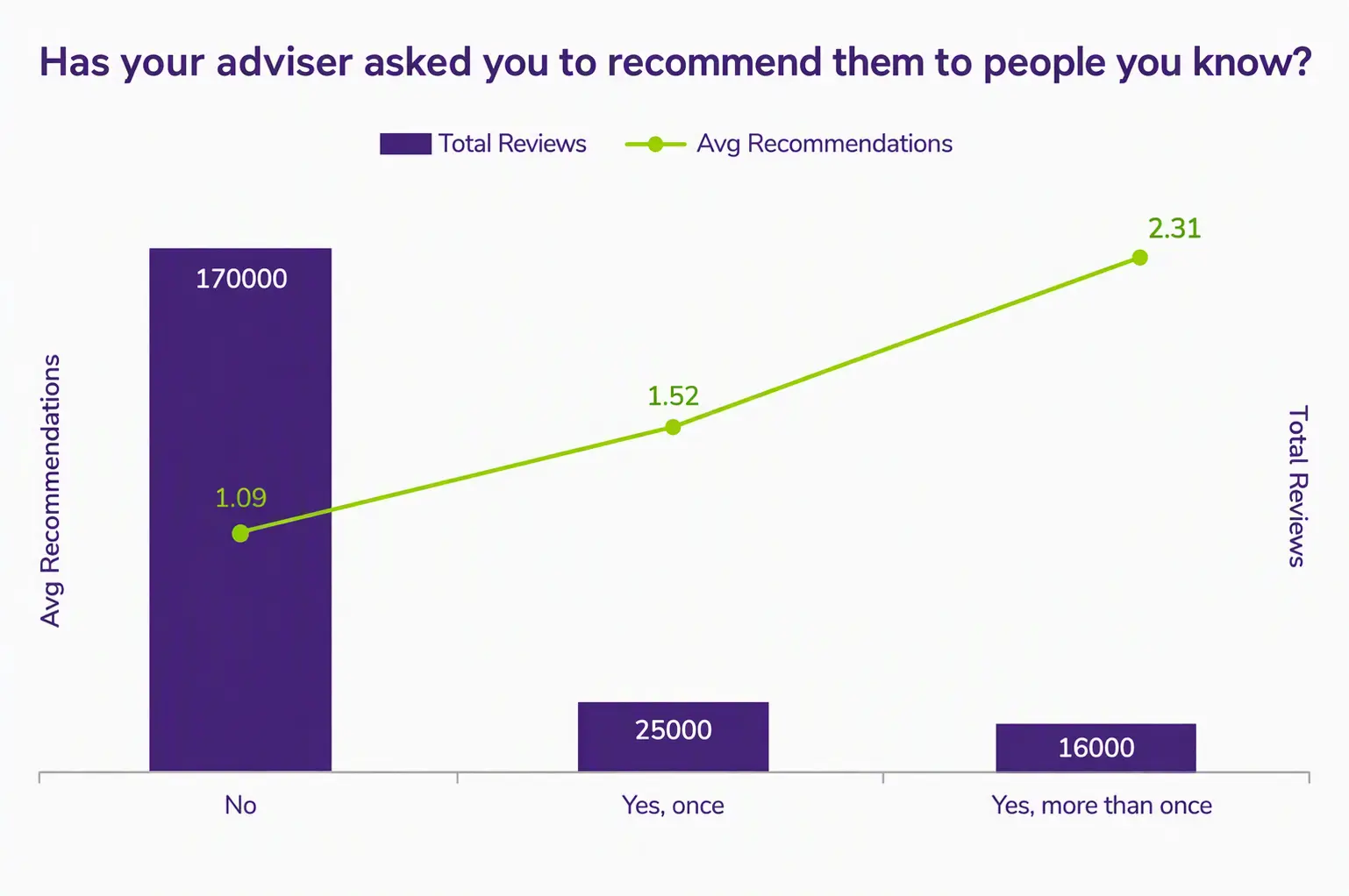
The reason is a relatively small but essential missing link: 50% of passionate advocates have never been asked to recommend their adviser. And even if advisers tell us they have asked for an introduction, clients clearly don’t recall it. The timing, clarity or context of that request often isn’t strong enough to remember, let alone prompt action.
50% of passionate advocates have never been asked to recommend their adviser.
The fix is simple and clear: ask for a referral more than once and you can double the number you receive.
Asking consistently is one of the easiest ways to increase referrals from existing clients. And it turns ad-hoc, unpredictable recommendations into a known and repeatable source of revenue.
For many advisers, that shift represents a multi-million-pound AUM opportunity already sitting within your client base.
Asking for a referral more than once can double the number of referrals you generate from a client.
What the data tells us about referral drivers
While asking is essential, it only works consistently when supported by delivering the right client experience. In this respect, the data highlights several clear levers for success.
1. A small group of clients drive the majority of referrals
Not all clients contribute equally. A relatively small segment, often described as “passionate advocates”, generate a disproportionate share of referrals. These are clients who:
Fully understand your value
Have strong trust and rapport
Feel confident recommending you to others, and will do so repeatedly
The most effective firms identify and prioritise these clients, rather than taking a blanket approach.
2. More clarity results in higher advocacy
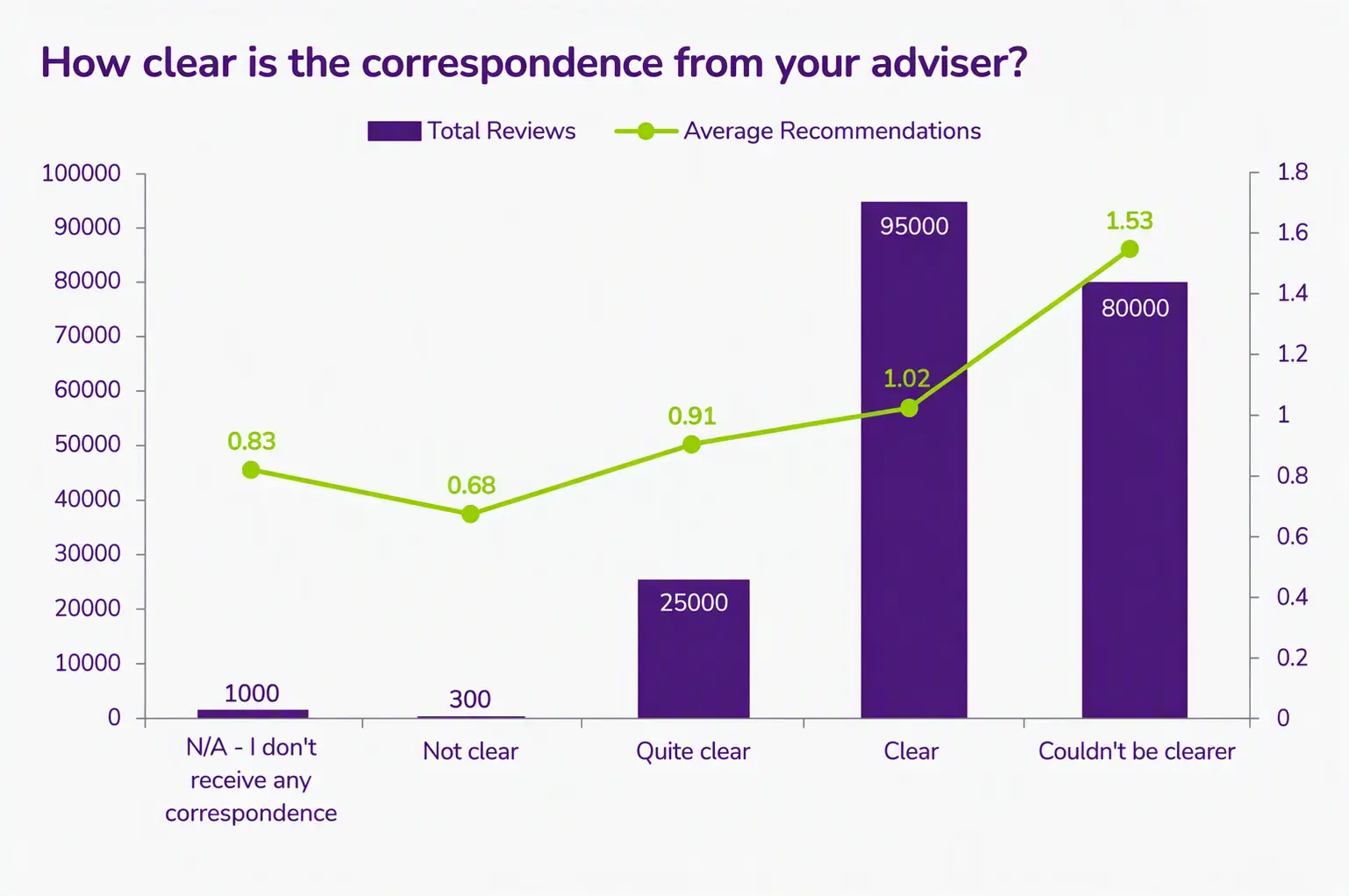
Clients who say their adviser’s communication “couldn’t be clearer” are 50% more likely to refer than those who simply describe it as “clear”. That distinction reflects the difference between broad understanding and feeling completely certain and confident.
The advisers who receive the strongest referral outcomes are those who:
Simplify complex information
Reinforce key messages consistently
Follow up meetings with clear, structured communication
Clients who find their correspondence “couldn’t be clearer” are 50% more likely to refer compared to those who find it “clear”.
3. Confidence drives referrals
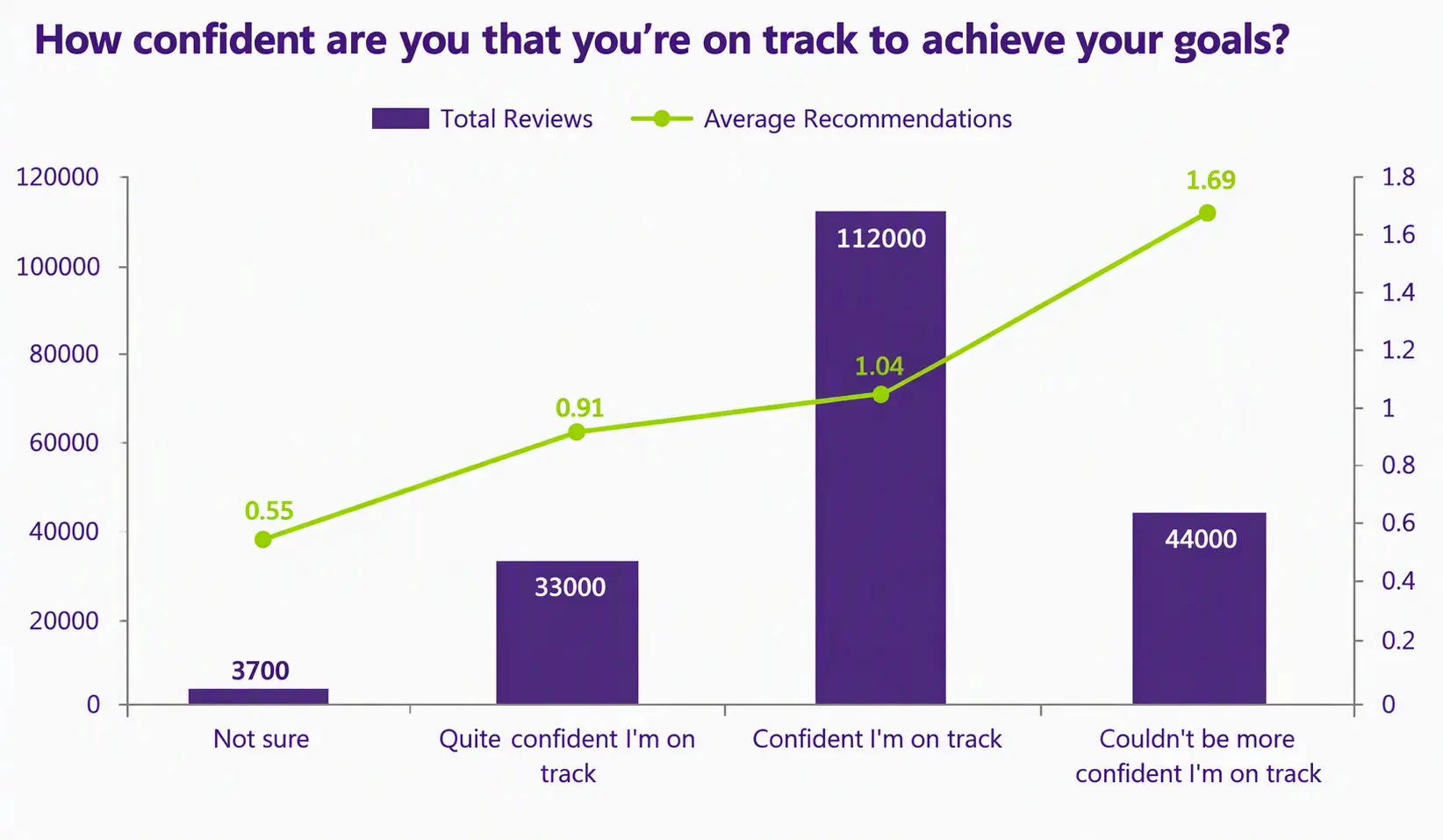
Clients who feel fully confident they are on track to achieve their goals are significantly more likely to recommend you.
That confidence doesn’t happen passively. It is actively built through:
Conducting regular progress reviews
Setting clear milestones
Establishing explicit check-ins during meetings
A simple question, “Do you feel confident you’re on track?”, can be a powerful driver of future referrals.
4. More conversations, more referrals
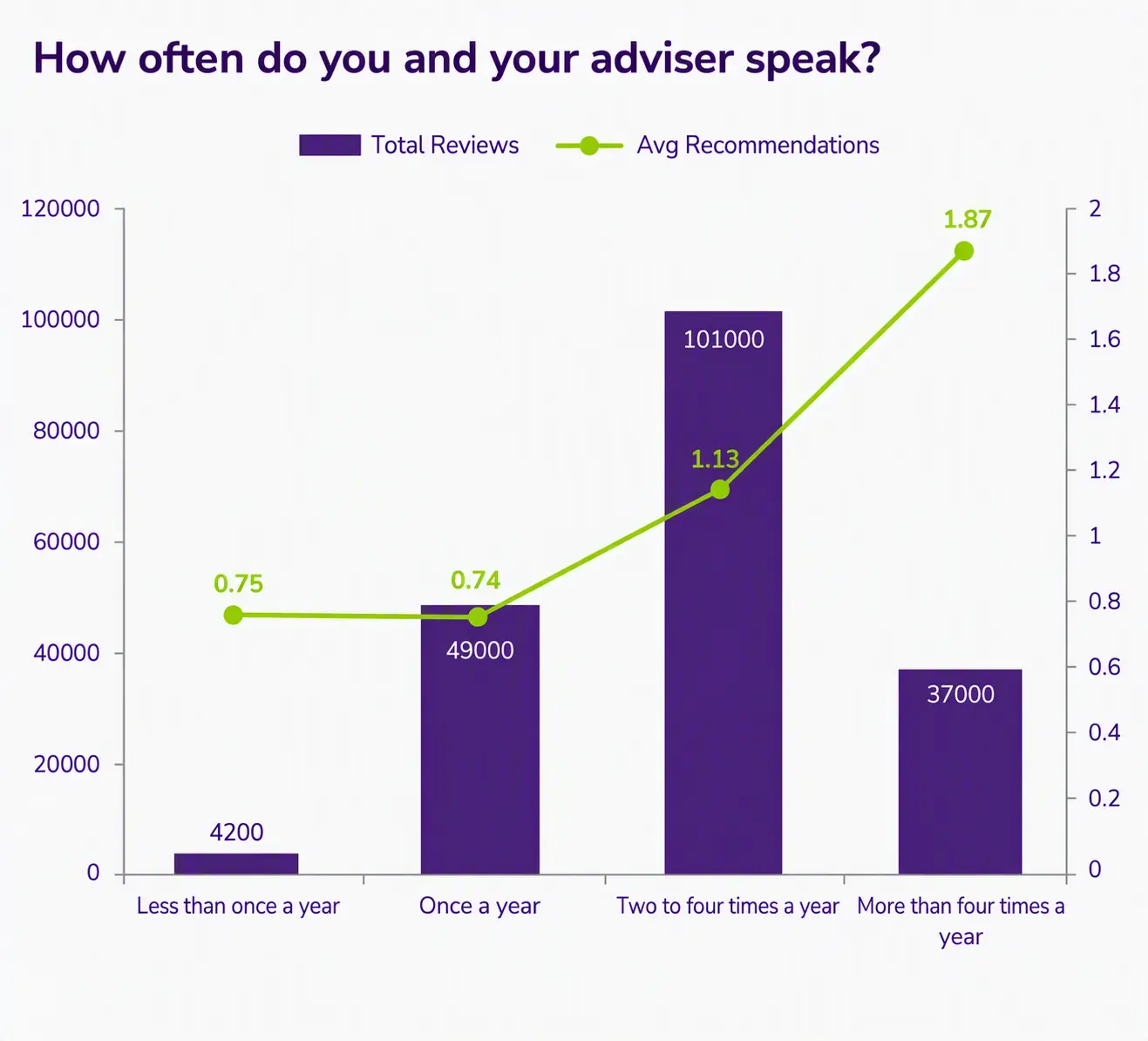
Frequency of contact is one of the clearest predictors of referral activity. Advisers who engage with clients more than four times per year see over a 50% higher likelihood of referrals compared to those who meet less often.
Each interaction creates opportunity to:
Reinforce value
Build confidence
Ask for a referral
A simple question, “Do you feel confident you’re on track?”, can be a powerful driver of future referrals.
“Of all our data points, clients feeling they couldn’t be more confident they’re on track has the biggest influence on referrals. It’s also the area where most firms have the biggest opportunity to improve.”
Emily Wastie Strategic Business Development Manager, VouchedFor
Clients who “couldn’t be more confident they are on track” are over 50% more likely to refer compared to those who are “confident”.
Lower-frequency contact leads to around 1.13 referrals per client
Higher-frequency engagement increases this by 50% or more
Advisers who speak with their clients “more than four times a year” see over a 50% higher likelihood of generating referrals compared to “two to four times”
The behavioural science: Why advisers don’t ask, and why clients would say yes
Despite the clear opportunity, advisers typically hesitate to ask. That’s normal. In fact, it’s common across firms of all sizes. The same concerns come up time and again:
“It feels uncomfortable”
“We don’t want to come across as salesy”
If these feel familiar, you’re not alone. But these barriers are driven by perception, not reality.
Behavioural science helps explain the reasons. When you think about asking for a referral, you’re likely to focus on the cost to the client: the time, effort or inconvenience involved. It can feel like you’re asking them to do extra work.
In practice, however, the opposite dynamic is at play. When you ask a satisfied client for a referral, it:
Encourages a natural desire to help in return (the principle of reciprocity)
Strengthens, rather than weakens, the relationship
The act of asking doesn’t create friction, it deepens engagement.
Clients experience a well-timed referral request as an opportunity to support someone they trust, and to extend the value they’ve received to others.
This mindset shift matters. Your clients aren’t waiting to be convinced to refer you. They’re waiting for you to ask them in the right way, at the right time.
Once you recognise this critical fact, asking for a referral stops feeling like a sales activity, and becomes a natural continuation of the relationship.
Your clients aren’t waiting to be convinced to refer you. They’re waiting for you to ask in the right way, at the right time.
From intention to action: Building a referral habit
Generating consistent referrals requires more than good intentions. It requires habit.
“The common denominator of success is forming the habit of doing the things that unsuccessful people don’t like to do.”
Albert E. N. Gray Speaking to life insurance professionals, 1940
The most successful advisers approach this through three lenses:
1. Mindset
Reframing referrals as a:
Natural outcome of delivering value
Way of helping others access advice
Standard part of the client relationship
2. Systems
Embedding referrals into existing processes:
Adding them to meeting agendas
Signposting them ahead of reviews
Aligning them to key moments in the client journey
3. Skills
Developing the confidence and structure to ask effectively means:
Being clear and specific
Avoiding vague or apologetic language
Guiding clients through the process
Who to ask for referrals and when?
Misconception
Common misconception is that you can only ask a satisfied client at the end of the year.
Reality
Reality is that you can ask anyone you have a trusting relationship with.
When?
In almost any meeting, formal or informal. Always put AOB on meeting agendas.
Where?
With any frequency you feel comfortable with – it is not a one-off activity with any one referrer. A single happy customer can yield multiple referrals.
A 7-step framework to ask for referrals
The difference between asking and succeeding lies in how the conversation is handled.
1. Catch the “magic moment”
The most effective referral conversations happen immediately after value is recognised. This might be when:
A client thanks you
You’ve solved a problem
Progress towards a goal is confirmed
These moments trigger reciprocity, making clients more open to helping.
2. Use a clear and structured ask
High-performing advisers avoid generic wording and instead use a simple framework:
The hook: who you are looking to help
The trigger: the challenge they are facing
The call to action: a simple, yet specific ask
For example: “We’re increasingly working with business owners who are within 12–18 months of a sale and aren’t sure what comes next.”
Do you know anyone in that position who it might be helpful for me to speak to?”
Specificity helps clients connect your request to real people in their network, moving the referral from an abstract idea to an action they can realise.
3. Prompt their memory
Most people do not keep potential referrals front of mind, so they need prompting. Help your client think more deliberately by guiding them towards relevant people in their network.
This shifts referrals from subconscious → conscious, making them far more likely to surface.
4. Give clients space to think
Most potential referrals sit below the surface. Clients need time to mentally retrieve them. This is where many advisers lose the opportunity, by filling silence too quickly.
A simple principle applies: Ask clearly, then pause.
5. Why asking more than once matters
One of the most powerful, and often overlooked, findings is the impact of repetition. When done appropriately, asking more than once strengthens, rather than damages, the relationship.
Clients who are asked multiple times:
Become more comfortable with the idea
Have more opportunities to think of relevant contacts
Provide significantly more referrals over time
It is not a one-off effort, but consistency that drives results.
6. Turning a ‘yes’ into a real introduction
Securing agreement isn’t the end goal. Execution means turning intent into opportunity. Support the process by:
Suggesting a simple email introduction
Offering to draft the wording
Asking to be copied into the introduction
Following up politely where needed
7. Close the loop
Just as importantly, effective advisers close the loop. When an introduction leads to a conversation, or a new client, they:
Thank the original referrer
Share appropriate updates
Reinforce the value of their action
This recognition makes future referrals far more likely.
“When a client says thank you, most of us instinctively reply ‘no problem’. But that’s the magic moment. Rather than brushing it off, act on it. The client has just acknowledged the value you’ve given them, and that’s the time to ask for their advice.”
Jonny Adams Head of Financial Services, SBR Consulting
Key takeaway: The road to growth
Clients are already willing to make the referrals that will increase your AUM growth. But they won’t act without a clear and consistent approach to activating that instinctive desire to help.
When advisers combine clear communication, frequent engagement, and a structured approach to asking, the results are significant. And not just in terms of referral volume, but also in real, sustained AUM growth.
It is not a one-off effort, but consistency that drives results.