
WEALTH MANAGEMENT INSIGHTS
The organic growth opportunity: How the right commercial strategy can double value multiples
5 minute read
The M&A landscape has undergone a tectonic shift over the last few years, leaving many wealth management firms at a serious disadvantage during negotiations.
The greatest M&A premium is no longer scale or revenue; it’s organic growth. Two firms with the same AUM could command radically different valuations based purely on their new client acquisition and wallet share expansion. One model suggests that high enough organic growth could double a firm’s EBITDA multiples.
But to understand why, we need to look at how wealth management firms view their industry.
How organic growth became crucial for enterprise value
Leaders have spent the last decade chasing scale at almost any cost. Firms with the right network or PE backing could grow their AUM rapidly through acquisitions, recruit their way through succession problems, and leverage institutional scale to outcompete smaller firms for lucrative sales.
Yet those strategies no longer deliver the same returns. A series of structural changes have made pure scale less important than targeted, strategic acquisitions:
- Technological disruption: Tools like roboadvisers threaten to steal market share from advisory firms, particularly those serving retail investors. This has led firms to see technology as an arms race, with leaders desperate to adopt the most advanced platforms and integrate them wherever they can to stave off the perceived threat of technological obsolescence.
- Integration Issues: Rapid acquisitions cycles often create operational friction. Over one-quarter of firms that are consolidating have had to stop because all they’ve done so far is aggregate and acquire other businesses, but they haven’t properly integrated. The resulting cultural misalignment and operational bottlenecks erode firms’ capacity to attract and retain clients. Referrals often dry up due to confusion around the brand name, and firms that sell equity can experience more than 2x higher client attrition.
- Changing demographics: Wealth is quickly changing hands, often moving to groups who are less likely to work with advisers. High-net-worth heirs have long been seen as a problem for established firms; just one-quarter are expected to keep their parents’ adviser. But investible assets are also controlled more by women, who are notoriously underserved within wealth management.
- Rising expectations: Advisory clients increasingly expect end-to-end service that blurs traditional boundaries. McKinsey found that demand for “holistic services” nearly doubled since 2023, placing pressure on firms that have built a large presence based on specific specialisations or serving a particular niche.
- Talent shortages: Advisers are retiring far faster than firms can replace them, leading to a heavy talent shortage within UK wealth management. The average adviser is now 58, and nearly three-quarters of trainees drop out of development programmes before they become fully fledged advisers.
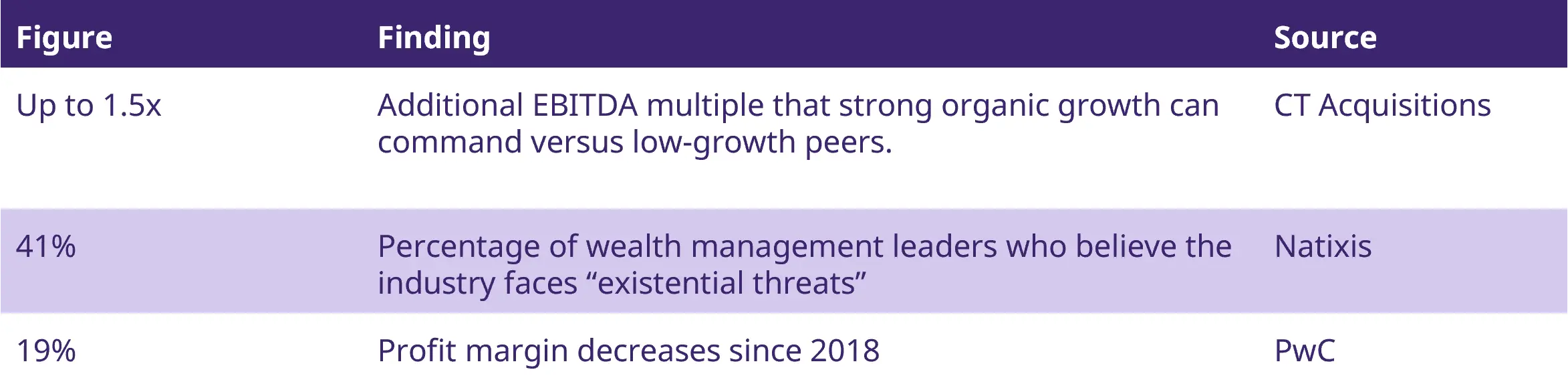
- Margin erosion: While revenue has continued to rise, margins have dissipated for most firms. Profit as a share of AUM has already fallen roughly 19% since 2018; it’s set to decrease by another 9% by 2030. Some of this is caused by increased operating costs, often ironically caused by complex mergers. But the four factors explored above also put pressure on advisers’ value propositions and threaten to drive down fees.
Combined, these structural challenges put even the largest firms under pressure, with 41% of wealth management leaders saying the industry faces existential threats. Those leaders want to acquire firms that will help them survive and thrive, not just inflate their AUM.
As Mercer Capital reports:
“Firms with demonstrated organic growth may be better positioned to negotiate favourable terms, whether in the form of less contingent consideration, more achievable earnout hurdles, or stronger rollover economics […] Recurring, diversified, profitable, and transferable organic growth signals durability and reduces perceived risk in both acquisitions and succession planning.”
The question is how valuable that durability really is when it comes down to drawing up terms.
How much can organic growth influence value multiples?
Nobody disputes that organic growth gives firms leverage within acquisition talks, but it’s important to stay level-headed. This is not an exact science: organic growth is nuanced and contextually relevant. One firm might have increased its client count reliably for multiple years, but if its total addressable market (TAM) is considered too small, acquirers are likely to discount that organic growth; past performance becomes less indicative of future prosperity.
As a result, estimates about the extent to which organic growth influences value multiples vary considerably. While some argue that firms add 0.5-1.0x EBITDA multiple per percentage point of organic growth, others argue that strong organic growth can produce up to 1.5x EBITDA relative to low-growth peers. One recent analysis found that valuation dispersion of 8x-13x+ EBITDA now exists between firms with similar AUM, driven not by size but by the quality and predictability of organic growth.
Equally, organic growth is not the only factor acquirers optimise for today. The ability to fill capability gaps across advisory services and technology adoption is also highly prized; geographic coverage and ownership of a specific audience niche also offer clear strategic value.
So for firms hoping to generate enterprise value, the goal is not simply to drive organic growth; it’s to do so in a way that is most attractive to potential acquirers.
What the ideal organic growth engine looks like
While every firm is appraised differently, based on their specific context and the acquirer, organic growth is almost always most valuable when it meets three basic criteria:
1. Structural
Acquirers are paying for the promise of future organic growth that will scale. Plenty of firms believe they can attract new clients post-acquisition; the extra resources and marketing support often solve advisers’ biggest organic growth barriers. But acquirers won’t pay a premium for growth they’ve enabled.
As a result, organic growth must not just be sizable but structural: the product of intentional systems rather than individual advisers with strong books and commercial talents.
Schwab recently found that top-performing firms don’t just stand out for their actual growth numbers; they are also far more likely to document referral plans and goals for both clients and business partners, as well as have a documented ideal client persona, client value proposition and marketing plan.
2. Explainable
Many wealth management leaders cannot quantify or even adequately explain what attracts new clients or how wallet share is won. They might have a pet theory about their firm’s success or their clients’ beliefs, but it’s rarely backed by hard data.
The ideal organic growth engine is not proprietary: it should be relatively simple to outline the value proposition, TAM, and commercial development programmes that deliver consistent results. This also shows strategic insight and awareness of the future; acquirers want to believe they are purchasing a firm that has thought through its next ten years of growth.
3. Predictable
Organic growth is an important metric, but its value is always contingent upon other variables, such as marketing, sales, and development costs. But because most firms lack clarity about exactly what causes growth, they essentially rely on guesswork to calibrate their spend across these areas.
The ideal growth engine is able to produce predictable outcomes based on specific inputs, enabling leaders to make strategic decisions to increase or decrease their investment based on their commercial and market context.
Gwendaline Mazzara, vice president and senior business consultant at Fidelity Institutional, puts it like this:
“Firms must consider how they harness value across the entire client lifecycle. It requires foundational internal readiness across talent, platforms, client segmentation, and offerings to effectively attract, qualify, nurture, close, onboard, and engage right-fit investors.”
Building a growth engine like this will help leaders gain leverage and maximise their M&A valuations. But it requires an end-to-end system, and at SBR, we’ve developed a three-triangle approach to develop that kind of system.
Based on 24 years working with over 2,000 advisers, we help wealth management firms excel across:
- Commercial Strategy: Develop a differentiated positioning and value proposition, based on up-to-date market intelligence, precise audience segmentation and focused targeting of the right profiles and personas.
- Enablement: Put the right commercial plans, processes and people in place with leadership from frontline managers who are able to inspire performance.
- Effectiveness: Develop advisers who are able to execute and drive organic growth as they have the habits of high performers in their skills, mindset and use of platforms.
Using this system, leading firms have been able to increase wallet share by 17%, improve conversions by 300%, and find 22% of their net new business targets within their existing adviser base.
Want to explore how it could help you deliver similar results and generate more enterprise value?
References
- https://mercercapital.com/insights/blogs/ria-valuation-insights-blog/2024/organic-growth-and-ria-valuations/
- https://sbrconsulting.com/podcasts/why-mergers-and-acquisitions-stalls-organic-growth-in-wealth-management/
- https://www.fa-mag.com/news/acquired-rias-see-client–advisor-attrition-accelerate-77447.html
- https://www.mckinsey.com/industries/financial-services/our-insights/the-looming-advisor-shortage-in-us-wealth-management
- https://www.moneymarketing.co.uk/news/new-initiative-launched-to-ease-adviser-shortage/
- https://www.cerulli.com/press-releases/the-financial-advisor-industry-has-a-headcount-problem
- https://www.pwc.com/gx/en/1/issues/reinvention/asset-wealth-management-revolution.html
- https://www.im.natixis.com/en-us/about/newsroom/press-releases/2024/financial-advisors-remain-optimistic-despite-the-impending-great-wealth-transfer
- https://mercercapital.com/insights/blogs/ria-valuation-insights-blog/2026/organic-growth-is-the-new-scarcity-premium/
- https://mercercapital.com/insights/blogs/ria-valuation-insights-blog/2024/organic-growth-and-ria-valuations/
- https://ctacquisitions.com/guides/ria-wealth-management-ma-multiples-2026/
- https://dyerbaade.com/resources/how-to-value-a-wealth-management-firm-in-the-uk-2026
- https://advisorservices.schwab.com/insights-hub/perspectives/ria-benchmarking-study-2026
- https://www.investmentnews.com/practice-management/what-sets-high-performing-rias-apart-healthy-growth-says-fidelity/257994